Technologies are increasingly rarely tools we consciously reach for. They have become an environment. They organise the flow of information, regulate the pace of work, support decision-making, learn our behaviours and record the traces of everyday life. They operate in the background, often remaining invisible, and yet they shape the way we remember, communicate and imagine the future.
The works presented at the Adaptive Breathing exhibition do not ask where technological development is heading. They are more interested in what it is like to live inside systems that constantly analyse and optimise. What can be negotiated within them? What can be reclaimed? What can be reinvented?
Slowing down returns throughout the exhibition. In Lennart Lahuis’s Anemochory, information exists only for a moment, dependent on the weather. Luiz Zanotello’s Tempo-Imagem reveals the way computer models observe the climate, while Zhao Zhou’s Bora: Bora shifts attention from the image to air, sound and movement. All three works remind us that technology always operates within a specific environment and is never entirely independent of matter.
At the centre of several works are the algorithms and infrastructures that organise everyday life. Tomo Kihara’s Game of Possible Lives shows how language models reproduce social imaginaries of biography, while Mark Cinkevich’s Navigating Militarized Futures exposes the political dimension of algorithms and data infrastructure. In Marcin Korbus’s Backups of War, immersive technologies do not serve as an escape from reality but allow us to draw closer to the experience of war through places preserved as digital testimonies.
Alongside systems, relationships appear. Fragmentations of Unity (So Kanno + Takuro Yonezawa + Yutaro Kyono) explores how community emerges between simple organisms that respond to one another. Sarah Seunghyun Park presents memory as a process that, like a storm, transforms space and leaves new configurations behind. In The Eight Spirits of Flesh, TZUSOO creates a fictional ecosystem in which questions of corporeality, care and reproduction go beyond biological and social norms. Gregor Różański’s Piece for 12 Scrollers takes as its starting point the most ubiquitous gesture of our time, scrolling, turning scattered attention into a collective performance.
This is not an exhibition about the future. Most of the technologies presented are already with us. Language models, surveillance systems and augmented reality operate beside us every day. The artists do not propose simple alternatives. Rather, they examine where, within these systems, room remains for one’s own pace, memory, body and imagination. Perhaps that is where adaptation begins, not as consent to existing conditions, but as a practice of defining one’s own way of being in the world.
Matylda Badera
Competition jury: Michał Grzegorzek, Karolina Hałatek, Paweł Janicki, Ksawery Kaliski, Ksawery Kirklewski, Norman Leto, Rosa Menkman, Günseli Yalcinkaya
Works
Anemochory
Lennart Lahuis · Installation
An installation that uses water vapor to create and disperse the word “Anemochory.” The title refers to the process by which seeds and spores are disp…An installation that uses water vapor to create and disperse the word “Anemochory.” The title refers to the process by which seeds and spores are dispersed by wind—a mode of movement determined by changing atmospheric conditions rather than by a planned direction.
At the center of the work is a device that produces mist in rhythmic cycles, briefly revealing the word inscribed within it. Moments later, the text disappears. Whether it remains legible depends on temperature, humidity, air movement, and time. Information has no permanent form here—it appears and disappears as environmental conditions change.
Breathing is understood simultaneously as the action of a machine, a repetitive rhythm, and a process taking place within an environment. Adaptation does not mean adjusting to a single system, but continuously functioning under changing conditions. By slowing down the process of reading, the work resists the logic of instant accessibility and constant optimization. Instead of a permanent message, it offers the experience of something that exists only for a moment.
The work develops themes present throughout the artist’s practice, which examines relationships between information and processes occurring in nature. By combining technology with phenomena such as evaporation, condensation, oxidation, and erosion, Lahuis creates installations in which information is not a fixed record but depends on material and environmental conditions. Anemochory asks when and under what conditions a message becomes legible, and how natural processes can influence the ways in which we receive and understand information.
BACKUPS OF WAR
Marcin Korbus · VR / AR experience
Backups of War addresses the consequences of the Russian Federation’s full-scale aggression against Ukraine and the war that has now been ongoing for…Backups of War addresses the consequences of the Russian Federation’s full-scale aggression against Ukraine and the war that has now been ongoing for four years. The artist presents the history of the conflict through spaces and objects transferred from the reality of war into virtual reality. Guided by the voices of people who experienced these events, viewers confront the scale of destruction and the consequences of violence. They move through virtual post-war spaces, becoming witnesses to traumatic sites—from a bombed church and an enormous missile crater created during the bombardment of Kharkiv to a basement in Yahidne, where Russian troops held more than 360 civilians in darkness for 28 days. The objects are presented using mixed-reality technology, referring to the war both literally and symbolically; among them are a monument protected by sandbags and a bullet-riddled car.
The project is based on authentic 1:1-scale 3D scans created in different regions of Ukraine, often with the participation of local residents, and made available online as digital testimonies of trauma. All scans used in the project were obtained under licenses or with permission from their creators allowing them to be presented as part of an exhibition. The use of immersive VR and MR technologies makes it possible to reach a younger generation familiar with the language of interactive media, while offering a different way of telling the story of war—not through a collection of images, but through an attentive experience of the places where these events occurred.
Bora: Bora
Zhao Zhou · Sound installation
The installation creates a sensory space of respite—a momentary break from the relentless rhythm of the contemporary built environment. Here, technolo…The installation creates a sensory space of respite—a momentary break from the relentless rhythm of the contemporary built environment. Here, technology neither demands attention nor turns itself into spectacle. Its presence is revealed through the movement of air and sound, which can be heard and felt, encouraging visitors to experience space through more than sight alone.
The installation defines an empty zone inside a tunnel made of aluminum frames, containing transparent modules that house 96 speakers. Together, they create a moving wall of sound and air. The resulting currents are both turbulent and delicate, giving air a material, almost haptic quality.
The work transforms the invisible into a physical experience. It creates an environment that is simultaneously disorienting and calming, where the perception of space is shaped primarily by hearing and touch. By shifting attention away from the dominant sense of sight toward the often-overlooked senses of hearing and touch, Bora: Bora challenges established modes of perception. The surrounding soundscape and swirling masses of air do not impose a particular direction of experience; instead, they invite visitors to surrender to change and movement.
The installation proposes an alternative model for experiencing technology—one in which innovation does not reinforce the dominance of the image, but deepens our engagement with ephemeral phenomena and invisible forces. It also refers to nineteenth-century attempts to grasp the invisible ether through theories of atomic vortices. In this sense, the work becomes a contemporary continuation of those explorations: through technology, it gives material form to what usually remains unseen. For a brief moment, Bora: Bora creates a space of respite for the body—a place of refuge from the dominance of the image while remaining part of the visible world.
A light installation using a swarm of robotic objects, the work asks what it means to be part of a community while maintaining one’s individuality. Tw…A light installation using a swarm of robotic objects, the work asks what it means to be part of a community while maintaining one’s individuality. Twenty-nine translucent tubes suspended above visitors’ heads are equipped with rotating mechanisms, RGB LEDs, and temperature sensors. Each element is simple, yet has its own orientation—a clearly defined front and back—allowing it to direct its attention toward both people and other objects.
The work takes as its point of departure the evolutionary moment when organisms developed a digestive tract and, with it, spatial orientation. The artists treat this feature as a primordial form of communication between organisms—a simple mechanism for directing attention toward the presence of others. The tubes detect human body heat and respond to movement by turning toward the nearest person, synchronizing the breathing rhythm of their lights, changing tempo and color, or moving away from one another. The installation is not observed from a distance; visitors enter it and become part of the relationships unfolding within it.
Six real-time choreographies, based on separate algorithms and accompanied by a four-channel soundtrack, explore the tension between the individual and the collective. The individual sequences refer to synchronization and its breakdown, dialogue between two objects, following the heat of the human body, and movements resembling schools of fish or flocks of birds.
Rather than pursuing the spectacular synchronization characteristic of many light installations, Fragmentations of Unity focuses on subtle gestures and relationships emerging through close contact. At times, the tubes respond to human presence; at others, they turn toward one another, creating situations that can be interpreted as expressions of interest, cooperation, uncertainty, conflict, or loneliness. The installation becomes a non-verbal study of attention and mutual recognition—an attempt to speak about social relationships and the experience of being alive through movement, light, and sound.
The work was commissioned by Common Nexus, Tokai National Higher Education and Research System. The research was funded through the JST CREST program (JPMJCR22M4) and the GAP Fund (Step 1) operated by the Tongali platform.
Game of Possible Lives
Tomo Kihara · Arcade game
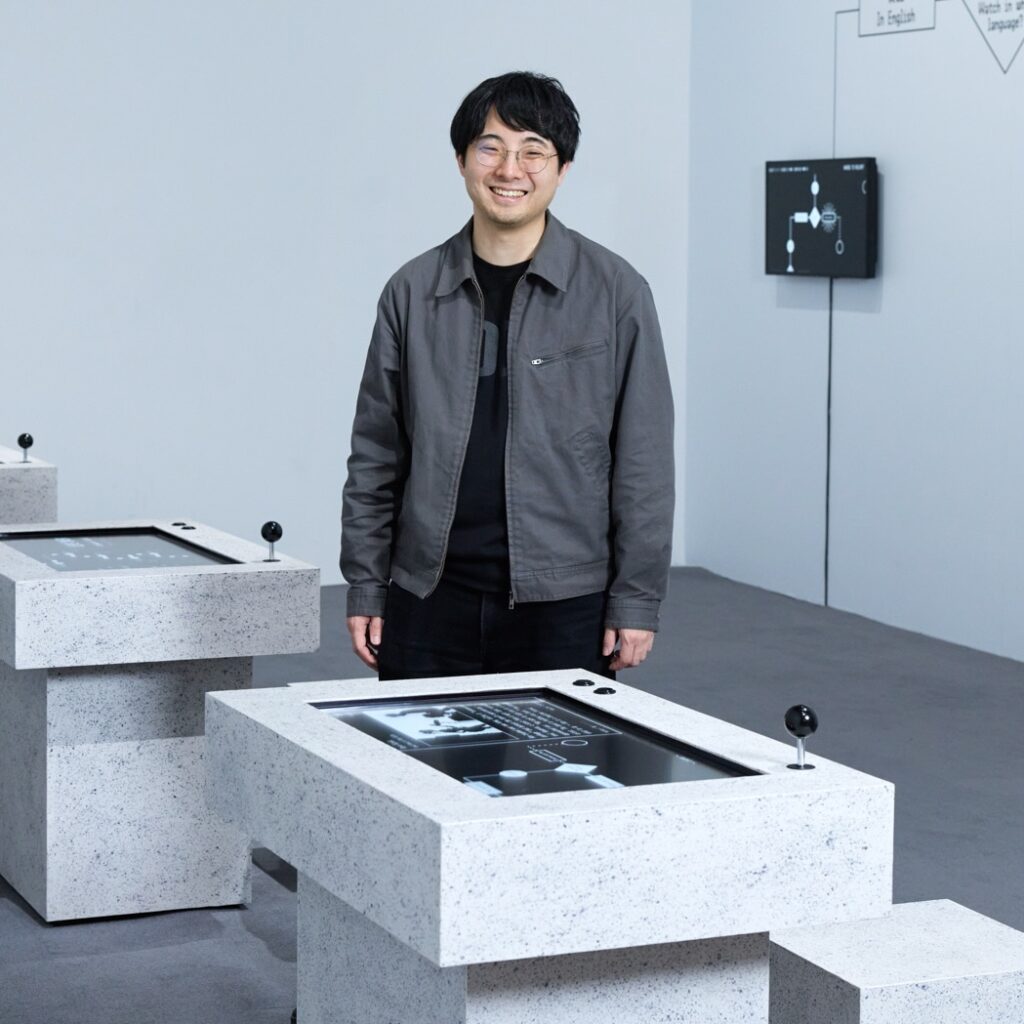
Game of Possible Lives is an arcade game in which a locally run AI model tells the story of a statistically probable person. Players guide a character…Game of Possible Lives is an arcade game in which a locally run AI model tells the story of a statistically probable person. Players guide a character through successive stages of life—education, work, relationships, and other major decisions—observing how each choice affects the course of events until the end of that person’s life. The work draws on a long tradition of games that attempt to contain human life within a set of rules, from the Indian Moksha Patam to Milton Bradley’s The Checkered Game of Life of 1860. Each reflected the assumptions of its era about what constituted a “good life.” Game of Possible Lives asks what changes when artificial intelligence takes on the role of narrator.
The game uses a locally running Gemma 3 language model to generate each story in real time. Every life begins with a fictional character created using census data from a selected country. Age, gender, place of residence, and income level are combined into a configuration that could plausibly exist in contemporary society. Because language models are trained on vast collections of human-created texts, the stories they generate reflect both dominant social patterns and the biases and inequalities embedded within them.
After a character’s life ends, players can return to an earlier moment and make a different decision, following an alternative course of events. In this way, the game allows different possible scenarios to be compared and invites reflection on the roles of chance, choice, and social circumstances. Running the model locally and preserving it in its present form turns the installation into an archive of the contemporary moment—a record of the ways artificial intelligence imagines human life in the early twenty-first century. In the future, it may be revisited as a testimony to the values, norms, and biases embedded in both data and AI models.
Navigating Militarized Futures
Mark Cinkevich · Computer game
An installation in the form of a video game devoted to the infrastructure of contemporary occupation. It begins from the premise that occupation today…An installation in the form of a video game devoted to the infrastructure of contemporary occupation. It begins from the premise that occupation today is no longer primarily about blocking the movement of people and goods, but about controlling the conditions under which those flows take place. Data—their collection, processing, and use to shape the future before it happens—assume particular importance.
The work refers to the situation in Belarus following Russia’s full-scale invasion of Ukraine. With the presence of Russian troops, control over surveillance systems and visual-data processing infrastructure became crucial. In 2023, a Belarusian decree designated the Russian company Positive Technologies as the principal provider of software for visual-data analysis and the integration of the two countries’ databases. The installation demonstrates how control over software, networks, and digital infrastructure becomes a contemporary form of domination, described as digital colonialism.
At the center of this infrastructure are algorithms that analyze data and assign people specific risk levels. Although presented as neutral and objective, in practice they are used to identify individuals considered threats to the state. Political decisions and repression thus acquire an appearance of technological impartiality. In the game, the visitor assumes the role of a character suffering from memory loss and guided by the creator of the surveillance system. At first, the goal appears to be disabling the system. Over time, however, it becomes clear that avoiding surveillance cameras provides the algorithm with additional data, helping it become more effective at recognizing human behavior. The game exposes the paradox of surveillance systems: even attempts at resistance can be used to further improve them.
The installation is accompanied by a printed diagram showing the technical infrastructure used to synchronize surveillance systems, while the game itself allows visitors to experience a city operating under constant observation. Navigating Militarised Futures demonstrates that contemporary control over territory increasingly takes place not through physical presence, but through digital infrastructure and algorithmic decision-making.
Piece for 12 scrollers
Gregor Różański · Performance
A piece for twelve scrollers. Twelve people, seated comfortably in a circle, generate twelve signals for amplification. Physical stupor and stillness…A piece for twelve scrollers. Twelve people, seated comfortably in a circle, generate twelve signals for amplification. Physical stupor and stillness versus the audiovisual dopamine loop and the noise of brainrot. A durational performance of overstimulation. A “silent and motionless” chorus (from the Greek χορός—“dance in a circle,” originally simply a “group circle”) performs without singing or dancing, yet still comments on the tragedy—or perhaps tragicomedy—of life.
The ancient Greek chorus used both movement and voice; later church choirs became stationary, focusing on singing while standing in place. This entropic chorus, however, barely moves and no longer uses its own voice. Its only movements are the postures and gestures involved in holding a smartphone and browsing content—we are together and separate at the same time. Phones are not instruments; they are already parts of our bodies. Or perhaps we are instruments for them? Who is connected to whom?
Theater, cinema, exhibitions—all fight the same enemy: the distracted, bored, half-present viewer, who becomes the protagonist of this event. A person staring at their phone is treated as a failure for culture—someone who must be corrected, disciplined, shamed, or “enchanted” again.
In classical and modernist approaches, distraction and attention deficit were the problem. Here, distraction becomes the material of art. Can the formula “art = life” go too far? Has it already crossed the horizon of the definition of “novelty” and come full circle like a dopamine loop?
We listen to the soundscape emitted by collective screen time and screenmaxxing. The intersection of art and technology turns out to be the intersection of boredom and chaos. When absurdity begins to feel familiar, one must imagine Sisyphus scrolling. Romanticizing procrastination is dangerous, but romanticizing constant work and hyperproductivity can be equally dangerous. At least if you are useless, you cannot be exploited. And yet even in our “free time,” our consumption can become a form of unpaid labor generating profits for corporations.
Artists generally do not accept the disengaged viewer as their intended audience. They assume attention is something to be activated, tested, compelled, or provoked. Piece for 12 Scrollers begins later—at the moment when that battle has already been lost in culture’s war against the stream of disinformation. It does not attempt to reclaim attention or aestheticize technology. Instead, it stages fragmented, dispersed attention itself as a collective form, treating media-consuming society as the contemporary equivalent of a chorus: seemingly present, synchronized, and audible, yet mentally elsewhere.
Joseph Beuys once said: “Every sphere of human activity—even peeling a potato—can be a work of art, provided it is a conscious act.” How conscious are we when we scroll mindlessly? Does art always require self-awareness?
SARAH
Seunghyun Park · 3D animation
A 3D animation that intertwines the story of a natural disaster with a personal experience of loss through the motif of a storm. The title refers both…A 3D animation that intertwines the story of a natural disaster with a personal experience of loss through the motif of a storm. The title refers both to Typhoon Sarah, which struck Korea in 1959, and to a close friend of the artist, Seunghyun Park, whose presence in her life was as intense as it was fleeting.
The work begins with a digital reconstruction of a house the two artists visited together. From this emerges a space in which collective memory and personal recollections overlap, and where what has disappeared still seems present.
The animation blurs boundaries between scales and materials. Rocks, wood, insects, wind, and floating debris intermingle, creating a world in which the spatial order is overturned by the force of the elements. Microcosm and macrocosm collide, and seemingly separate elements begin to function according to a shared rhythm. Chaos gradually develops its own structure, while recurring motifs form a narrative constructed primarily through movement.
Sarah explores how catastrophe undermines the stability of the world, disrupts existing orders, and changes the way space is perceived. Architecture disintegrates, leaving only traces and memories behind, while the boundary between a material place and memory becomes increasingly indistinct.
Tempo-imagem
Luiz Zanotello · Mixed-media installation
A transmedia installation whose starting point is the Portuguese word tempo, meaning both time and weather. This ambiguity becomes a point of departur…A transmedia installation whose starting point is the Portuguese word tempo, meaning both time and weather. This ambiguity becomes a point of departure for reflecting on the role of technical images and language in an era of climate crisis and artificial intelligence, which is increasingly responsible for recording, analyzing, and predicting environmental changes.
The installation uses a system that searches publicly accessible weather cameras and surveillance feeds observing the sky, seas, forests, deserts, glaciers, and rivers in real time. A computer-vision model detects changes appearing in the transmitted images and determines how they are presented. By slowing down the analytical process, the work reveals a stage in the operation of machine-learning models that usually remains invisible: the extraction and comparison of image features used to model climatic phenomena.
The installation draws attention to the uneven distribution of infrastructure used to observe the climate. Areas with fewer available weather cameras appear on screen more frequently, reversing the dominant geography of visibility. The result is a multiperspectival image of the world that is not based on a single privileged point of view. Each presentation of the work is different—its course depends on the exhibition’s location and its distance from the cameras used by the system.
Tempo-Imagem refers to the history of media art, entering into dialogue with Michael Snow’s 1970 film La Région Centrale, in which the automated movement of a single camera played a central role. Instead of one perspective, the installation proposes a network of dispersed observation points, presenting the world as a system of multiple simultaneously existing times, places, and processes—both natural and technological.
The work was created in collaboration with Ricardo Vieira as part of the European Media Art Platform residency program at gnration, with support from the European Union’s Creative Europe Culture program.
The Eight Spirits of Flesh
TZUSOO · 3D animation
A 3D animation set in the fictional world of Agarmon.
The film was created entirely by hand in Blender—from modeling to rendering—by TZUSOO and tea…A 3D animation set in the fictional world of Agarmon.
The film was created entirely by hand in Blender—from modeling to rendering—by TZUSOO and team TZUSOO (Lloyd Marquart and Zion König), with whom the artist has collaborated for five years. In an era of AI-generated imagery, the work deliberately rejects automation of the creative process, emphasizing the value of manual digital labor. Every scene and every character was created from scratch. The music was created in collaboration with cellist and composer Maarten Vos.
The world of Agarmon emerges from sexual energy that does not lead to fertilization or birth. Its point of departure is female sexuality associated with the desire to create life, yet sensual experience occupies the central position. The work also grows out of the artist’s personal history—a dream of motherhood that gave way to the life of an independent artist. This individual experience is situated within the broader social context of contemporary South Korea, a country with the world’s lowest birth rate, where the female body becomes a site of tension between motherhood, career, autonomy, and patriarchal expectations.
Combining bioart with post-digital practices, The Eight Spirits of Flesh reflects on contemporary understandings of life, kinship, and care. It proposes viewing relationships between humans, technology, and living organisms as a space of care, coexistence, and the collective creation of a world.
We use cookies to personalise content and ads, to provide social media features and to analyse our traffic. We also share information about your use of our site with our social media, advertising and analytics partners who may combine it with other information that you've provided to them or that they've collected from your use of their services. read more